
THE RACE TO NET ZERO WITHOUT WOMEN?

Articles

-

By Aziliz Le Rouzo | March 8th, 2022

In the midst of a global climate crisis, where and to whom capital is allocated is key in determining whether we can reach our climate goals. The lack of female representation – at the level of investors, venture capital funds, and companies – constitutes a major risk, as women’s representation is an essential condition for innovation, catalyzing economic growth, productivity and cohesion. While female-led businesses outperform in capital productivity by 96%, this incredible potential is left untapped. Recent statistics from 2020 in Central and Eastern Europe (CCE) show that women-founded startups received only 1% of the funding, 5% went to mixed-gender founding teams, and 94% to all-male teams1.

For the first time this year, we are publishing statistics on the gender funding gap for the Nordic cleantech ecosystem. Underrepresentation of women in the tech, industry 4.0 and energy sectors is particularly problematic, and we are excited to present brand new statistics from these areas. The study below looks at the distribution of venture funding across funding stages, countries and cleantech segments based on gender representation within the founding teams.

Women in Cleantech Investments: Unite!

We know the cleantech ecosystem is formed by a majority of men and we are keen to change that reality. We want to welcome you, woman working in a VC, CVC or with innovation systems to join our members network for 6 months free of charge.

Are you interested and want to know more? Reach out to us!

Overview of the funding landscape

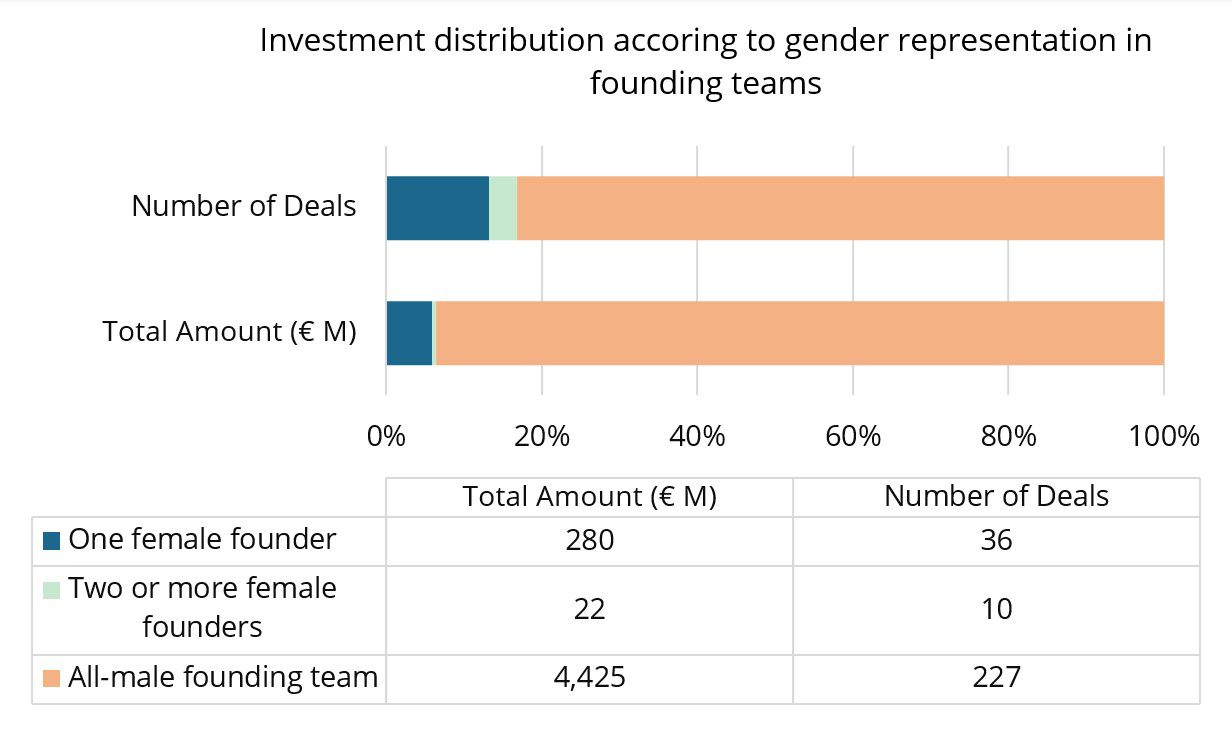
This graph shows that in the Nordics in 2021, investments made in companies founded by women represent 6% of the total amounts invested. 13% of the deals went to companies with at least one female founder while 4% of the deals went to companies with two female founders or more. The lion’s share of investments went to all-male founding teams in which 94% of the capital was invested.
Inequalities across funding stages

What stands out from the two graphs below is that the distribution of funding across funding stages is identical for companies with all-male founding team versus companies with at least one female founder when you look at the deal volume or number of deals. What differs is the distribution of value across these deals. 82% of the capital going to all-male teams comes from later-stage deals, while this figure is only 26% for female-led teams (by this, we mean teams comprising one or more female founders). Female-led teams get most of the funding from early-stage deals, that is Series A and Series B rounds, as well as other round types ranging from 2.5 M € to 12 M €. This suggests that even when female-led startups do receive later-stage funding, the size of the deals is likely to be smaller than for all-male founding teams.
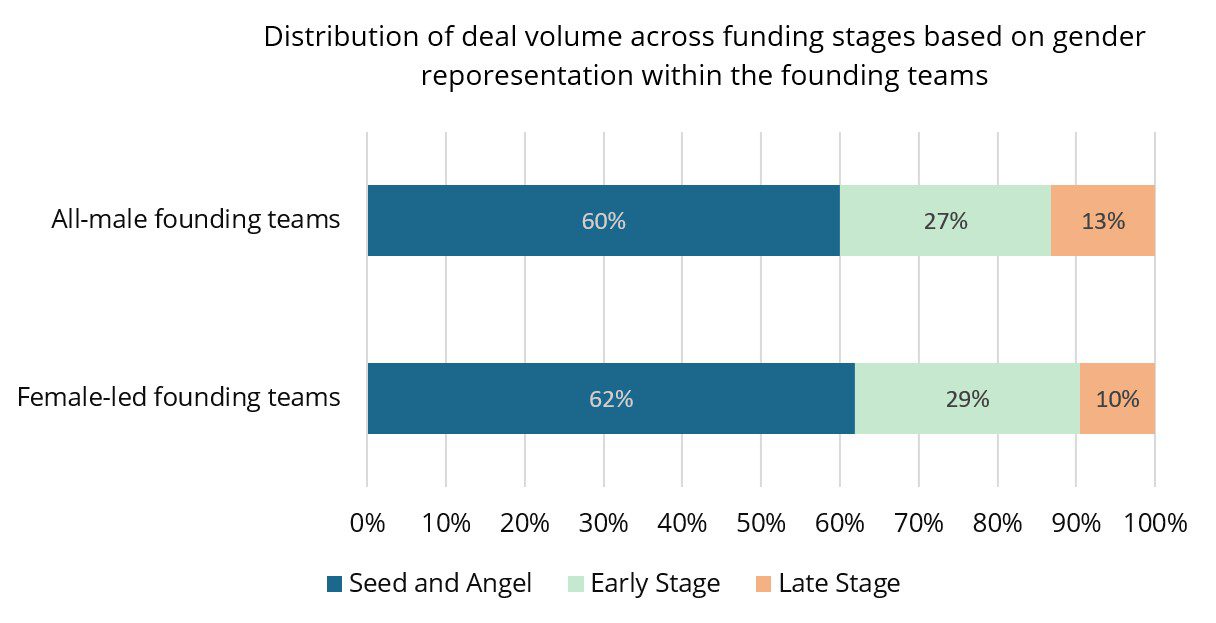
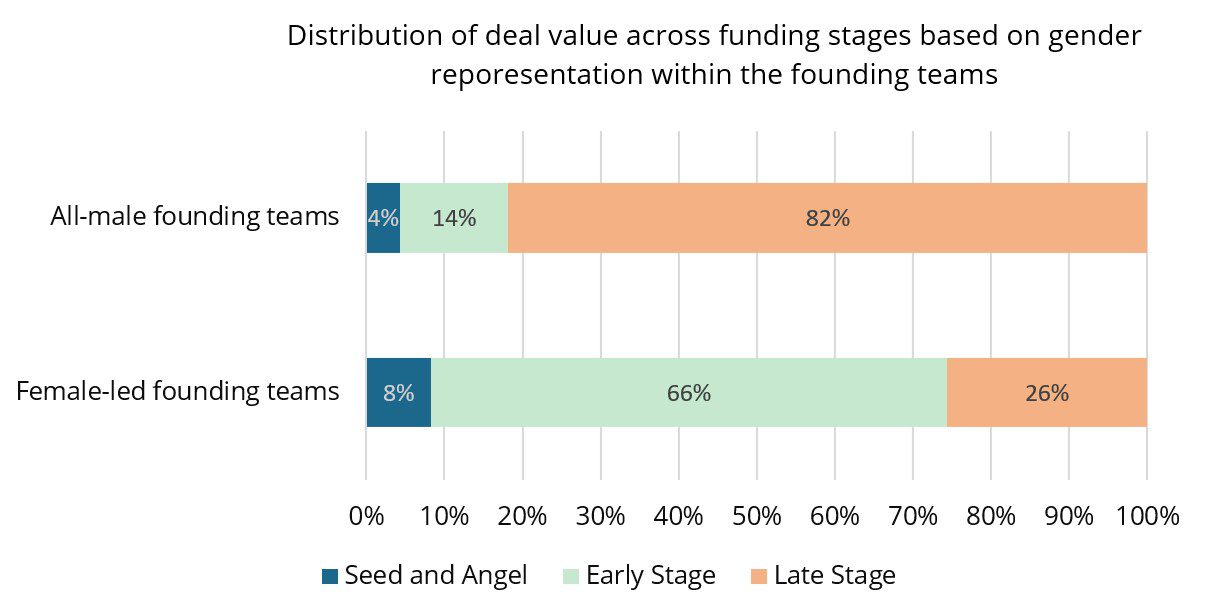
Inequalities across countries

Looking at the distribution of investments across countries, Denmark clearly stands out from its Nordic neighbors. Denmark shows the best statistics in terms of gender equality with 31% of deals going to female-led teams, representing 41% of the total amount invested. Norway, on the other hand, shows striking inequalities with a similar funding distribution as that of the CCE region.
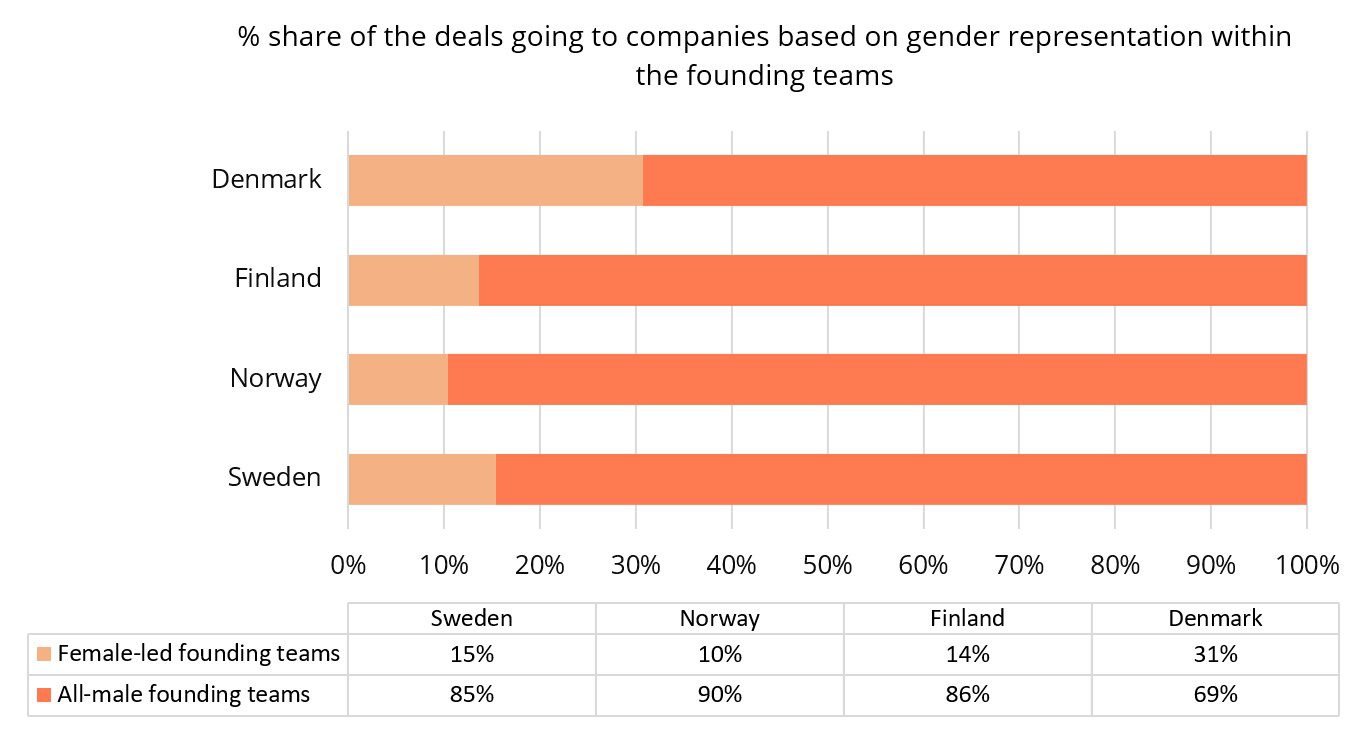
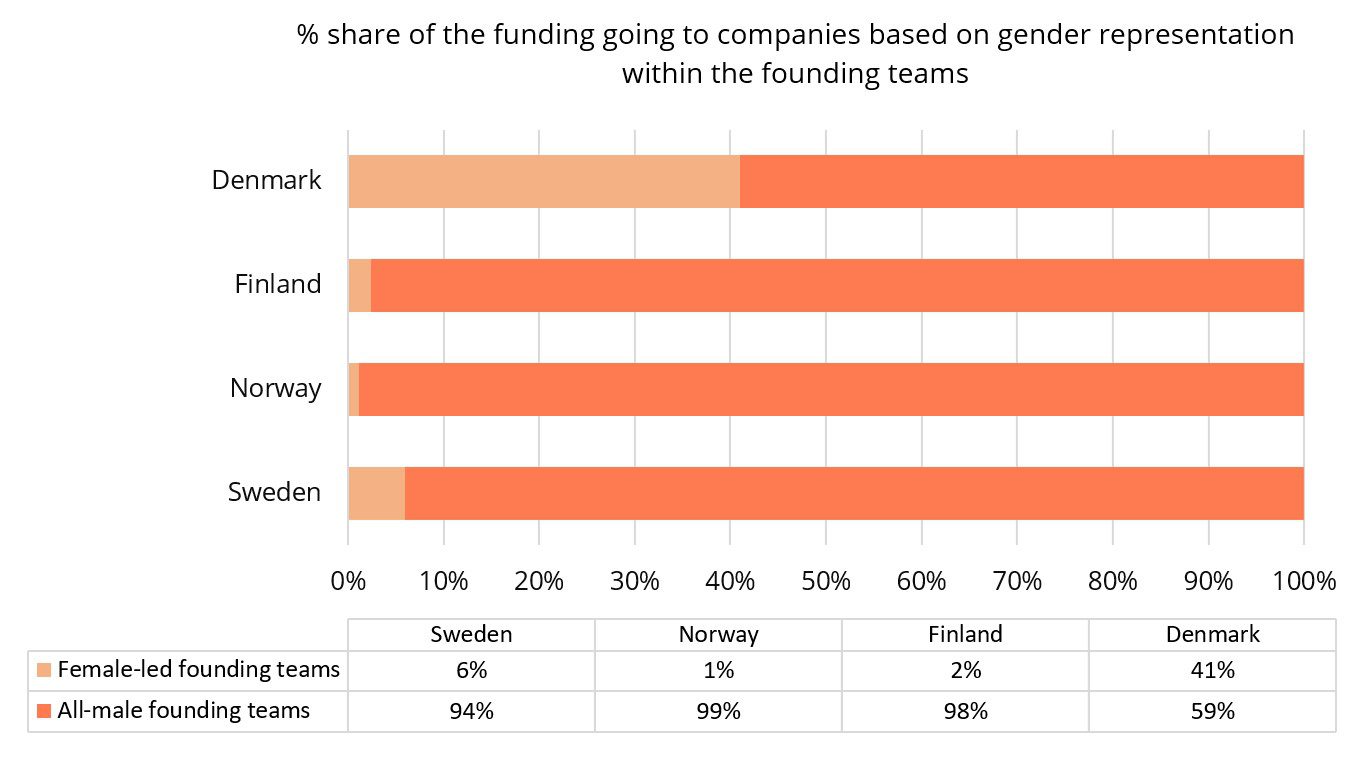
Inequalities across cleantech segments

Disparities across cleantech segments are also striking. While as much as 40% of the deals in the agricultural sector went to female-led startups, other segments show figures closer to 15% and the Energy Storage and Energy Infrastructure segments did not have a single deal going to female-led startups. Looking at the percentage of funding going to female-led teams, figures show even greater inequalities. In the Transportation and Logistics sector for example, while 23% of deals went to female-led teams, this represented only 12% of the amount invested in the sector.
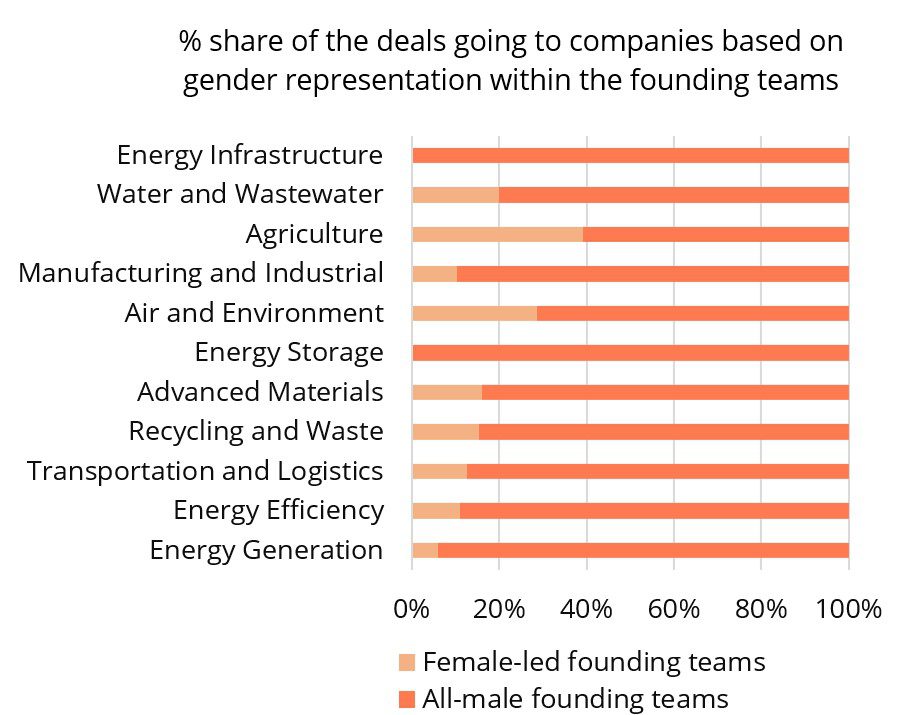
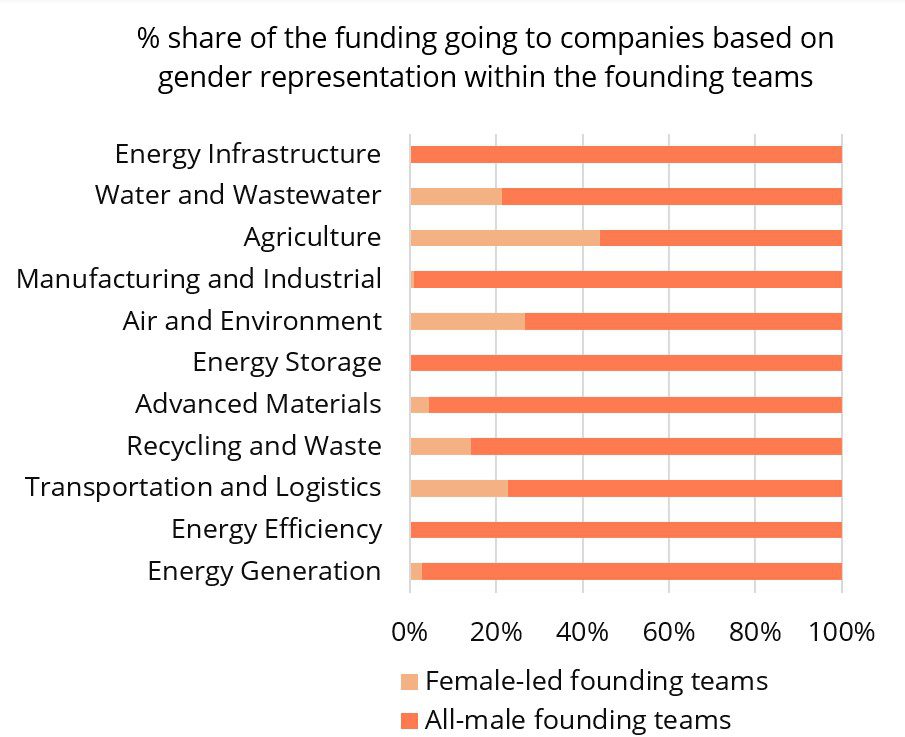
Our research shows that there is a major funding gap in the Nordic cleantech ecosystem. Female-led startups receive an insignificant share of the capital invested in the sector. While Nordic countries have long been championed as leaders in gender equality, this is not reflected in investment activities. As a whole, Nordic countries show the same funding disparities as the CEE region. Interestingly, Denmark stands out from its Nordic neighbors with more than one third of funding going to female-led startups. We are still, however, far from achieving equality, and women are missing out on a chance to shape our future. Or rather, we are all missing out on a better future shaped by women. Failing to address this gap constitutes a big risk, as greater female representation is not only a key driver for performance but also essential in building an inclusive, sustainable future.

References:

1 European Women in VC; Unconventional Ventures; Experior Venture Fund. (2021). Funding in the CEE region – Through the lens of gender diversity and positive impact. https://ceereport2021experiorvc.unconventional.vc

THE RACE TO NET ZERO WITHOUT WOMEN?2022-03-08T16:57:39+01:00

GENDER EQUALITY AND THE UNTAPPED POTENTIAL TO TACKLE THE CLIMATE CRISIS

Articles

-

By Aziliz Le Rouzo | September 9th, 2021

“Small side note looking at the team page of your presentation [14 pictures of men]: when do you hire your first female employee?” – Valery Prunier, Open Innovation Director Europe & International at EDF

“Interesting to see that there is not a single woman on the staff list.” – Boel Swartling, Serial entrepreneur and Angel Investor

This is some of the feedback that our jury for the 10th edition of the Nordic Cleantech Open provided to one of the 139 start-ups that applied this year. For 10 years, the Nordic Cleantech Open competition has served as an observation tower for the up-and-coming cleantech innovation trends that will support the transition to a low carbon reality. The whole competition cycle, which encompasses applications, jury evaluations and events, aims to focus the attention of international investors and industrials on cleantech innovations, accelerating their access to the global market and thereby reducing carbon emissions.

Women in Cleantech Investments: Unite!

We know the cleantech ecosystem is formed by a majority of men and we are keen to change that reality. We want to welcome you, woman working in a VC, CVC or with innovation systems to join our members network for 6 months free of charge.

Are you interested and want to know more? Reach out to us!

While the evaluation of the teams’ strengths and weaknesses are part of the jury assessment, the lack of gender diversity is rarely pointed out, despite the field being largely male-dominated. In fact, there has been little discourse in the past regarding gender representation, whether it is within the applying teams or the jury panel itself. What is certain is that neither are gender balanced. While we have seen an increase in the number of women-founded start-ups in this year’s Top 25 compared to last, the imbalance is still striking. Bringing this issue to light is merely acknowledging the tip of a giant iceberg, which we believe has a large role to play in tackling the climate crisis.

Climate Crisis – the role of investors

As the latest IPCC report warns, climate change presents widespread, rapid, and intensifying effects, and immediate large-scale action is our last hope to limit global warming to 1.5 degrees above pre-industrial levels1. There is still a possibility of achieving that goal. Clear milestones have been set, spanning across all sectors and technologies, offering a narrow pathway which requires all stakeholders to take concerted action today and every day after that for a liveable future.

In this global transition, venture investors have the extraordinary power to support the leading technologies of tomorrow. By deciding which founders receive funds, which businesses stand a chance at success and which products get brought to market, venture investors have an undeniable power to influence societal norms.

Who are these venture investors?

A recent report released by European Women in VC, using data from 2016 to 2020, reveals that only 10% of European VCs have a gender-mixed general partnership team2. While junior level positions see progress in gender equality, the same cannot be said of the upper echelons. The gender imbalance in VC firms is critical and has large repercussions on investment decisions. In fact, it is considered one of the major obstacles to funding women-led start-ups.

On the start-up scene, gender disparity is also striking. The latest PitchBook data3 indicates that despite a record amount of capital invested so far this year in Europe, female founders have received only 0.7% of the total funding, or €400 million (about $473 million). Since we did not find these statistics for start-ups in the cleantech sector specifically, we are collecting that data ourselves and plan to release gender statistics for cleantech start-ups next year. What is clear, is that this lack of diversity at the founder level prevents capital from reaching teams, products, and solutions which would be representative of a more inclusive society.

This very problem was highlighted by one of the Nordic Cleantech Open jury last year:

“I would recommend bringing some gender diversity to your team to grasp the power of different perspectives, experience and talents. Even more so since I imagine a large portion of your customers are female.” – Julian Klaiber, Investment Associate at Munich Venture Partners

Capital is too often allocated to products and services that reflect the values of an ‘old-boys club’, regardless of their market potential. While women-led businesses outperform in capital productivity by 96%, this incredible potential is left untapped2. Not only does this funding gap lead to riskier decisions by investors, it also drives the capital towards inventions which are potentially short lived. A recent scandal around yet another unnecessary feminine hygiene product developed by men illustrates that risk well4.

Investing with a gender and climate lens?

In the midst of a global climate crisis, where and to whom capital is allocated is key in determining whether we can reach our climate goals. While investments in solutions that tackle climate change need to be deployed, the importance of gender in building long-term climate solutions should not be underestimated.

Jessica Robinson, author of Financial Feminism: A Woman’s Guide to Investing for a Sustainable Future, stresses how important the role of women is in unlocking a sustainable future:

“There are so many different aspects to explore when we talk about the role that women can and already are playing in addressing the climate crisis. As founders and entrepreneurs, we are seeing more and more successful companies founded by women that are focused on sustainability and climate solutions. I genuinely believe, because I see this first-hand, that many women in business are looking to solve global challenges. At the same time, we also know that women as investors and financial decision-makers are seeking positive societal and environmental impact through their money decisions. We have the evidence that women tend to think about the long-term impact of their investment decisions and so we can bring this all together to really make a difference. If we can encourage women to be active gender-lens investors, supporting and funding female founders who are focused on delivering climate solutions, we can unleash so much potential.” – Jessica Robinson, Founder and Managing Director at Moxie Future

To conclude, the latest climate statistics show that we are running out of time to limit the magnitude of climate change. Gender lens investing should be seen as an important lever for bringing forward successful climate solutions that take into account and seek to address the gender-differentiated effects of climate change5. Let’s not risk leaving this huge potential untapped!

References:

1IPCC. (2021). Climate Change 2021: The Physical Science Basis. Contribution of Working Group I to the Sixth Assessment Report of the Intergovernmental Panel on Climate Change [Masson-Delmotte, V., P. Zhai, A. Pirani, S. L. Connors, C. Péan, S. Berger, N. Caud, Y. Chen, L. Goldfarb, M. I. Gomis, M. Huang, K. Leitzell, E. Lonnoy, J. B. R. Matthews, T. K. Maycock, T. Waterfield, O. Yelekçi, R. Yu and B. Zhou (eds.)]. Cambridge University Press. In Press

2 European Women in VC; Unconventional Ventures; Experior Venture Fund. (2021). Funding in the CEE region – Through the lens of gender diversity and positive impact. https://ceereport2021experiorvc.unconventional.vc
3Hodgson, L.  (2021). Senior female VCs call out major funding disparity in Europe. Pitchbook. https://pitchbook.com/news/articles/senior-female-vcs-call-out-major-funding-disparity-in-europe

4Mahdawi, A. (2021). Pinky Gloves are just the latest ludicrous attempt to monetise the vagina. https://www.theguardian.com/commentisfree/2021/apr/21/pinky-gloves-are-just-the-latest-ludicrous-attempt-to-monetise-the-vagina

5Biegel, S. & Lambin, S. (2021). Gender and Climate Investment: A strategy for unlocking a sustainable future. https://www.wocan.org/sites/default/files/Gender%26ClimateInvestment-GenderSmartReport-Feb21.pdf

GENDER EQUALITY AND THE UNTAPPED POTENTIAL TO TACKLE THE CLIMATE CRISIS2021-09-17T15:21:01+01:00

The Nordics at the heart of the hydrogen revolution

Green hydrogen for a net zero Europe 

Green hydrogen is gaining incredible momentum worldwide as it is one of the key technologies to reach the net zero target. As such, it is a central element to the decarbonisation of energy systems under the European Green Deal. Produced using electrolysis powered by renewable energy sources, or by non-electrolysis methods from biogenic sources such as waste or biogas, its carbon intensity is minimal. The promise of green hydrogen therefore relies in its potential to make the large-scale integration of renewables possible by enabling energy players to convert and store energy as a renewable gas. Finally, its versatile use across industries puts the technology at the centre of building a clean, secure, and affordable energy future. 

While green hydrogen could account for up to 24% of the final energy consumed in 2050, reducing GHG emissions by 560 million tonnes annually, this will require considerable scale-up supported by substantial investments. 

The role of the Nordics 

In this context, the Nordics present a massive opportunity for the scale up of green hydrogen. Strong cooperation across the Nordic countries coupled with the renewable capability from the North Sea through offshore wind, the Swedish steel industry, Icelandic energy production, underground storage opportunities in Denmark, and Norwegian expertise with hydrogen, all create opportunities across the value chain. Developments happening at a Nordic level could not only contribute to establishing Europe as a strong player on the global scene, but it would also allow other European countries to divert from grey hydrogen purchased on the international market. While Nordic countries have the potential to become the first movers on the green hydrogen scene, there needs to be support both from the public and private sector to compensate for the colossal production costs. There are already front-running examples of hydrogen initiatives in the Nordics, which have attracted the attention of private investors.  

Private Investment Trends

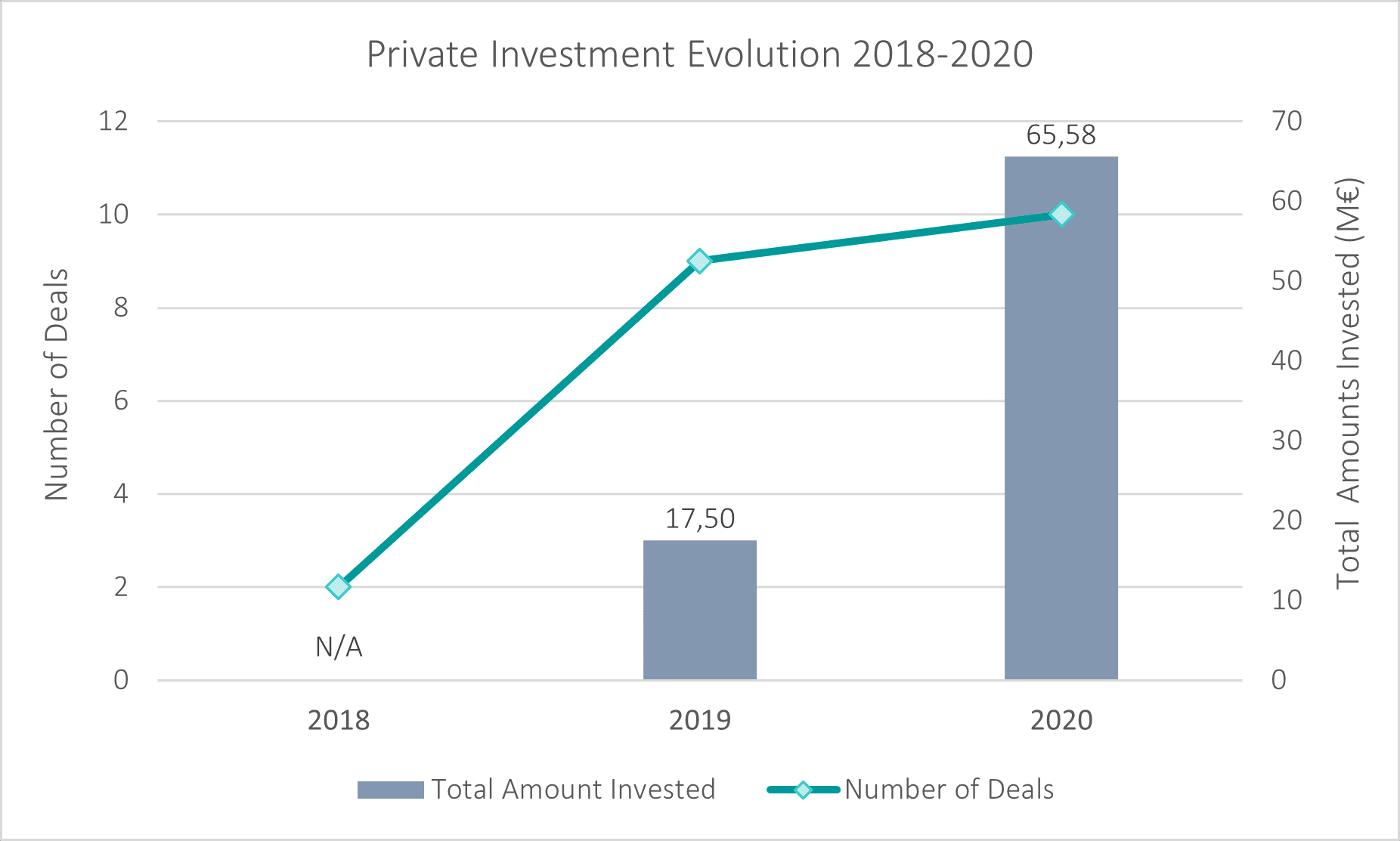
We have identified 31 promising start-ups in the field, 12 of which received private funding in the last three years. The average amounts invested have skyrocketed, going from 2,5 M in 2019 to 7,29 M in 2020. The total amounts invested per deal between 2019 and 2020 increased by 275%, reaching 65 M in 2020. When looking at the number of deals secured, there is a clear divide between 2018, where only two deals were recorded, and 2020 where we recorded 10 deals. This recent surge in private capital towards hydrogen technologies in the Nordics sends strong signals that these countries are already taking a step ahead 

Alfa Laval, member of Cleantech Scandinavia’s network, has recently partnered with Liquid Wind, that will develop facilities to combine green hydrogen with biogenic carbon emissions to form a liquid carbon neutral fuel, eMethanol. 

“This is an important partnership as we together with other major players will be part of the growing Power-to-X market, and thereby drive the development of technical solutions that will have an impact on future fuel options” says Susanne Pahlén Åklundh, President of the Energy Division. “With collaborations like this we expand the technical borders and contribute to create a more sustainable society.” 

Alfa Laval is an investor and partner in the Liquid Wind Power-to-X consortium to advance eFuels together with Siemens Energy, Haldor Topsoe and Carbon Clean. As a liquid this hydrogen-derivative can meet the needs of industry which is incompatible with hydrogen as a gas, such as shipping. 

“We are very happy to strengthen the Liquid Wind consortium with a world class Swedish industrial player with unparalleled experience. Their valuable knowledge will increase efficiency and deliver additional shared value” says Claes Fredriksson, CEO and Founder of Liquid Wind. 

Who are the key actors in the Nordics? 

Described below are the five companies, from the 31 mentioned above, that raised the most private capital in the past three years. 

Green Hydrogen Systems (Denmark) designs and manufactures efficient, standardised, and modular electrolysers to produce green hydrogen with renewable energy. They raised 28 M in a venture round led by Nordic Alpha Partners. 

Cell Impact (Sweden) supplies advanced metal flow plates for hydrogen fuel cells. The high-velocity impact technology used allows the production of high-volume and cost-efficient bipolar flow plates. They secured 24 M € on Nasdaq First North Growth Market. 

myFC (Sweden) develops micro fuel cell technologies addressing the hybrid relationship between fuel cells and batteries. They secured 12 M € on Nasdaq First North Growth Market. 

ZEG Power (Norway) is developing a technology for highly efficient production of hydrogen and/or electric power from hydrocarbon fuels, with integrated CO2-capture. They secured 11 M in private capital from a range of investors including AP Ventures, Mirai Creation Fund and Nysnø. 

HPNow (Denmark) developed autonomous electrochemical hydrogen-peroxide generators which produce ultra-high purity H2O2 directly at the point of use. They secured a 5 M deal with AP Ventures and Evonik Industries. 

Sources

Hydrogen Roadmap Europe, Fuel Cells and Hydrogen Joint Undertaking, 2019

Seizing the EU’s man on the moon moment, Cleantech for Europe, 2021

A Nordic hydrogen industry for Europe and beyond, InnoEnergy, 2021

Alfa Lava, Press Release, 2021-04-06

The Nordics at the heart of the hydrogen revolution2021-04-14T10:17:12+01:00

Sustainable City Finance videos already available!

The Smart City Business Event was a 3-day-long event full of workshops with some of the most advanced actors in the Smart and Sustainable City arena in Europe. Promoted by RVO, ITEA, Vinnova and Cleantech Scandinavia, one of the series of the event focused on the side of Sustainable and Smart City finance. The main goal was to discuss the views held by cities and investors, and how business models and novel financial instruments could have the potential to support the climate and sustainability transition.

This series of four workshops was framed within the City Finance project within the Swedish research program Viable Cities. It was developed by Cleantech Scandinavia, Stockholm Environment Institute and Stockholm School of Economics. Despite all the issues raised by the participants and all the different perceptions, there seems to be an opportunity for cities to become more sustainable and that there are several mechanisms that can be used to fund the transformations that the smart and sustainable city requires.

If you want to learn the main takeaways of these workshops, we have summarised them in the following short videos.

The City Perspective

Strategies that cities can follow to address sustainability issues according to those working in the urban policy arenas.

The role of private investors

What is the role of investors and their views regarding sustainable and smart cities?

Funding Mechanisms

Great discussion on ways to finance the Sustainable Smart city in different contexts.

The business case

Listen to different strategies to improve urban sustainability with different business cases.

You can also see the entire playlist here.

If you wish to see the entire workshop, get in contact with us at alicia@cleantechscandinavia.com and we will send you a link to the full discussion.

Enjoy the viewing!

Sustainable City Finance videos already available!2021-05-20T17:55:10+01:00
Go to Top