
Q4 2023: Quarterly Briefing – Nordic Investments
Dear Cleantech Scandinavia Member,

As many of you know we entered a partnership with Breakthrough Energy last year to establish Cleantech for Nordics. It is a coalition of Nordic investors and entrepreneurs that have come together to engage with Nordic (and European) policymakers to inspire them to take action to accelerate growth in Nordic cleantech.

In this project we have started to communicate regularly in different ways. We write papers and articles and drive certain processes on for example how to solve the cleantech scale up investment gap and to promote cleantech innovation in general. We have started to publish a Quarterly Briefing from the Nordics that contains everything from investment statistics to the latest in terms of policy development, scale ups, funding models etc.

It feels natural that we would share this with our members and therefore you will receive these Q-briefs in good time before they are published to the general public. We hope you will appreciate these and we welcome any kind of feedback you may have.

Best Regards

Laura and Magnus

Q4 2023: Quarterly Briefing – Nordic Investments2026-01-02T20:44:09+01:00

New podcast: Innovations with Impact. Bintel

How can data help us manage our waste more efficiently and help us reduce emissions? The first episode on the Innovations with Impact from Impact Cafe will answer this questions thanks to Michael Wictor, CEO of Bintel, a new solution that aims to increase recycling rate and household waste reduction. Click and listen!

Who is in the podcast today?

Michael Wictor

CEO

Bintel

Alicia Requena.

Host. Impact Assessment Manager.

Cleantech Scandinavia.

New podcast: Innovations with Impact. Bintel2022-04-25T11:10:57+01:00

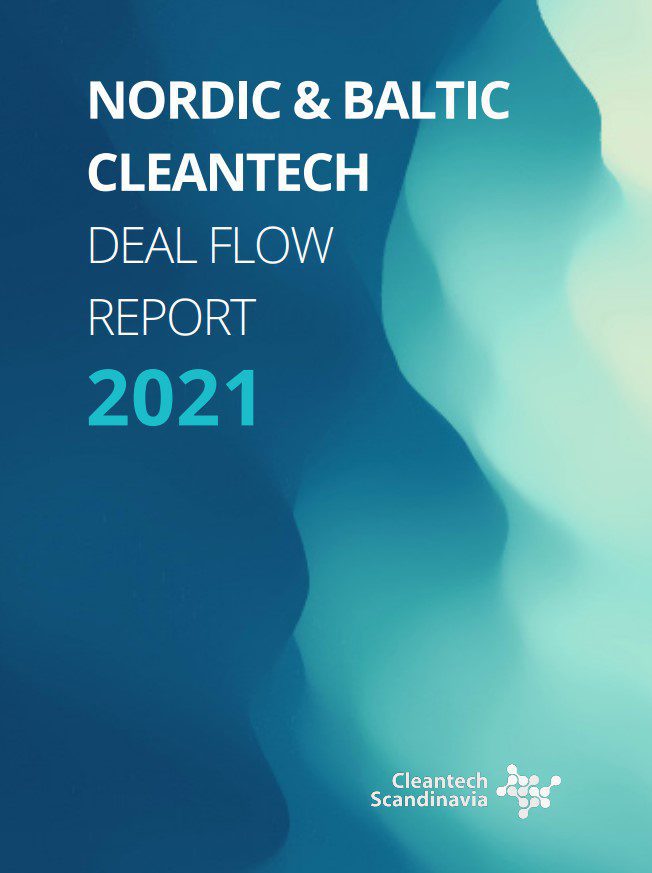
NEW REPORT ON PRIVATE CLEANTECH INVESTMENT TRENDS IN 2021

Interested to read more?

2021 sees remarkable growth in cleantech investments.

With a total of 6.46 Billion € invested in Nordic and Baltic cleantech startups, this year marks a transformation for the cleantech ecosystem. This trend is in line with a booming European venture landscape as funding for European startups overall increased by 159% this year. By comparison, private investments in the Nordic cleantech sector increased by 241% from 2020 to 2021. Considering both the Nordic and Baltic countries, this figure reaches an impressive 252% increase.​ This growth is driven by an increase in larger deals, where 2021 saw a doubled share of deals ranging from 10 M € to 20 M €. Investing strategies are shifting in response to emerging regulations such as the EU’s Sustainable Finance Disclosure Regulation and the accelerated focus on environmental, social and governance (ESG) criteria in private markets. 2021 boasts many encouraging signs that high-impact innovations will get the funding they need to scale up and lead the transition to low-carbon economies.

A venture landscape increasingly dominated by non-Nordic investors.

The share of investment rounds that included non-Nordic European investors doubled compared to 2020, while the share of rounds that included non-European investors increased by 5 percentage points. Together, investment rounds that included non-Nordic investors represent 87% of the total amount invested. In order to better understand the origin of the funding, we collected new data on up to five investors per round. This analysis revealed that investors from 30 different countries were involved in the 311 private venture rounds collected this year.

Sweden’s cleantech innovation scene faces increased competition from its Nordic and Baltic neighbours.

While Sweden still claimed the lion’s share of investments this year, the Nordic leader is facing increasing competition from its neighbours. Norway experienced the strongest growth in investments amongst Nordic countries, with a total of 929 M € invested. Looking at the Baltics, Estonia is attracting an increasing number of deals. The Baltic champion raised 75 M € through 21 deals providing growing competition to Finland and Denmark.

Investment focus in line with net zero targets?

The Transportation and Logistics sector dominated the scene this year, with an 82% increase in its deal volume, now representing 16% of all deals. While this sector has a key role to play in the transition to low-carbon economies, e-mobility solutions are enjoying a hype which comes at the expense of other high-impact technologies. While showing a similar deal volume, significantly less was invested in the Agricultural sector this year, despite the world’s food systems being responsible for more than one-third of global anthropogenic greenhouse gas emissions. Large emission-reduction opportunities are left untapped and accelerated action is needed in key sectors such as agriculture, manufacturing and industry to reach our climate goals. Investors need to target nascent technology areas with high impact potential to accelerate sectoral tipping points.

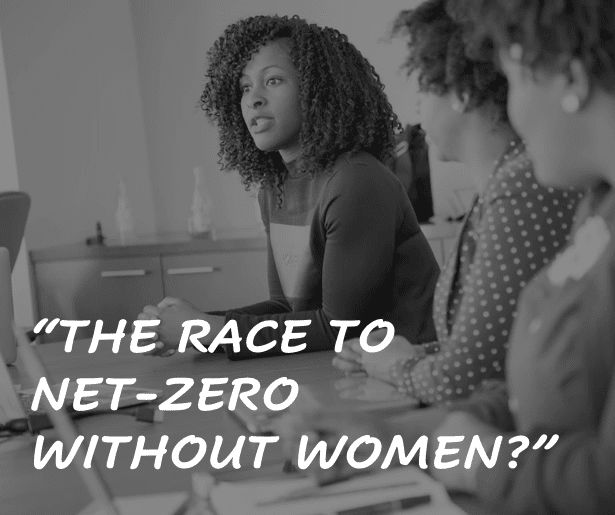
The race to net zero without women?

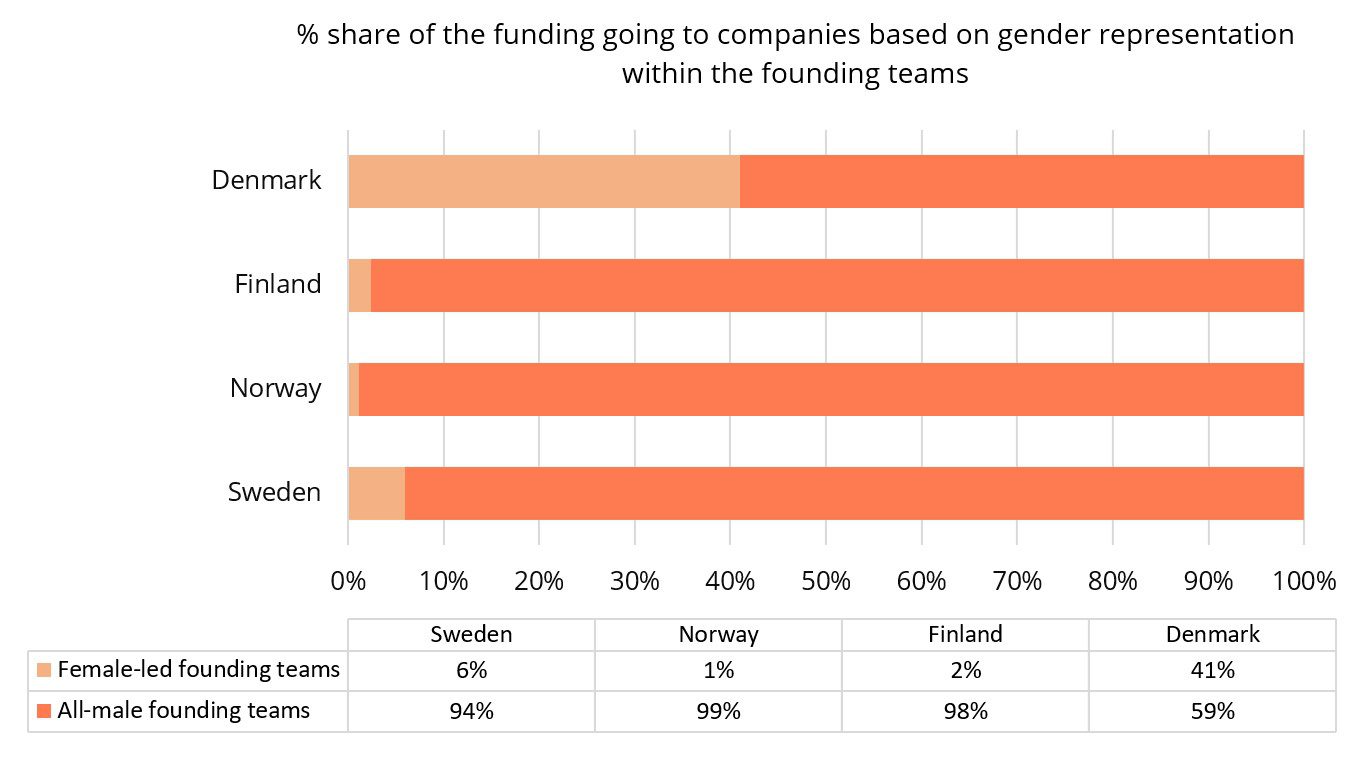
Brand new statistics that we have developed this year show that there is a major funding gap in the Nordic Cleantech Ecosystem. Female-led startups receive an insignificant share of the capital invested in the sector. While Nordic countries have long been championed as leaders in gender equality, this is not reflected in investment activities. As a whole, Nordic countries show the same funding disparities as the CEE region. Interestingly, Denmark stands out from its Nordic neighbors with more than one third of funding going to female-led startups. We are still, however, far from achieving equality and women are missing out on a chance to shape our future. Failing to address this gap constitutes a big risk as greater female representation is not only a key driver for performance but also essential in building an inclusive, sustainable future.

Download the Report

NEW REPORT ON PRIVATE CLEANTECH INVESTMENT TRENDS IN 20212026-01-02T19:57:37+01:00

THE RACE TO NET ZERO WITHOUT WOMEN?

investment

-

By Aziliz Le Rouzo | March 8th, 2022

In the midst of a global climate crisis, where and to whom capital is allocated is key in determining whether we can reach our climate goals. The lack of female representation – at the level of investors, venture capital funds, and companies – constitutes a major risk, as women’s representation is an essential condition for innovation, catalyzing economic growth, productivity and cohesion. While female-led businesses outperform in capital productivity by 96%, this incredible potential is left untapped. Recent statistics from 2020 in Central and Eastern Europe (CCE) show that women-founded startups received only 1% of the funding, 5% went to mixed-gender founding teams, and 94% to all-male teams1.

For the first time this year, we are publishing statistics on the gender funding gap for the Nordic cleantech ecosystem. Underrepresentation of women in the tech, industry 4.0 and energy sectors is particularly problematic, and we are excited to present brand new statistics from these areas. The study below looks at the distribution of venture funding across funding stages, countries and cleantech segments based on gender representation within the founding teams.

Women in Cleantech Investments: Unite!

We know the cleantech ecosystem is formed by a majority of men and we are keen to change that reality. We want to welcome you, woman working in a VC, CVC or with innovation systems to join our members network for 6 months free of charge.

Are you interested and want to know more? Reach out to us!

Overview of the funding landscape

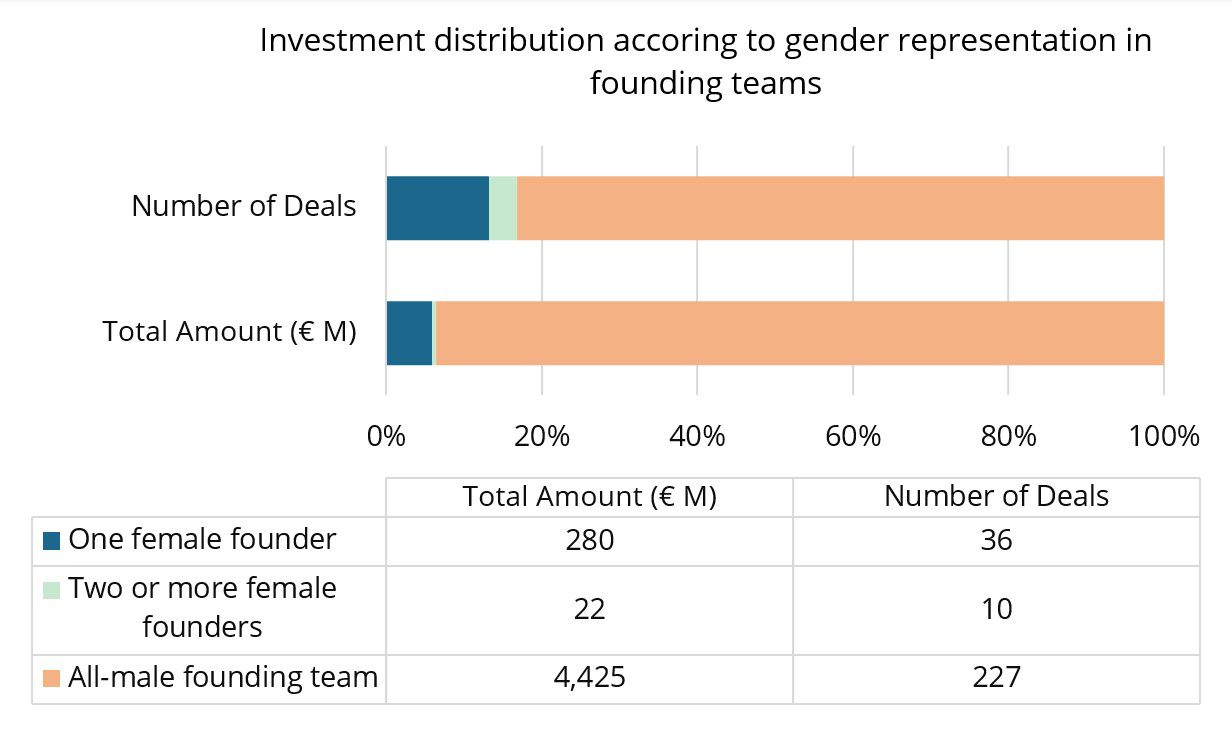
This graph shows that in the Nordics in 2021, investments made in companies founded by women represent 6% of the total amounts invested. 13% of the deals went to companies with at least one female founder while 4% of the deals went to companies with two female founders or more. The lion’s share of investments went to all-male founding teams in which 94% of the capital was invested.

Inequalities across funding stages

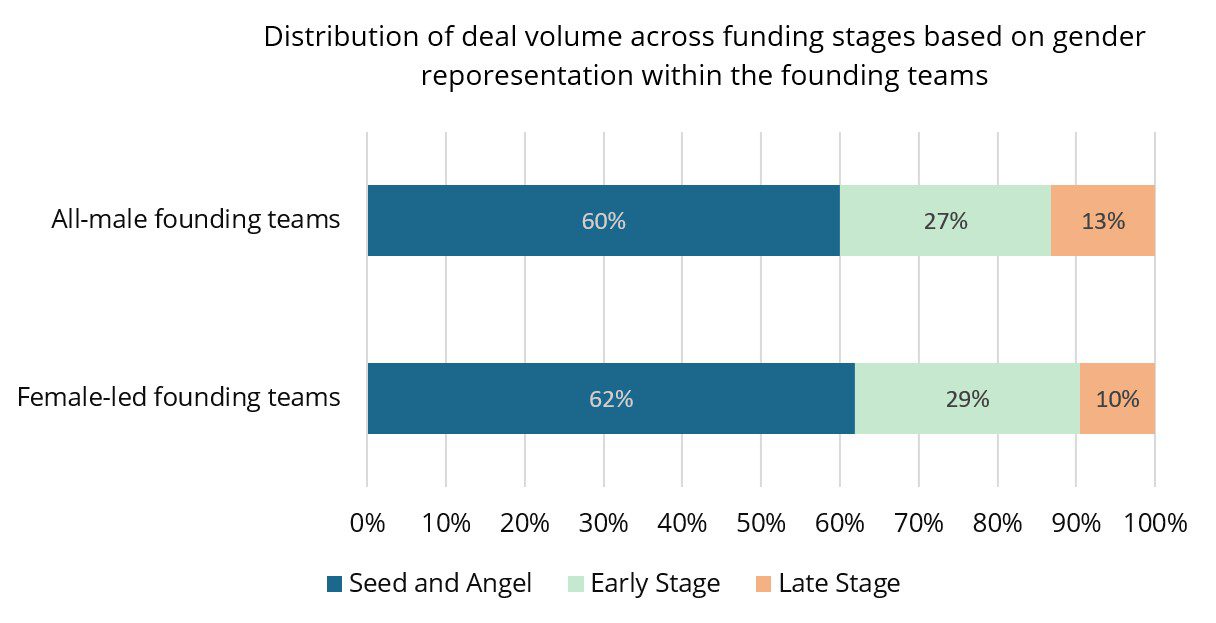
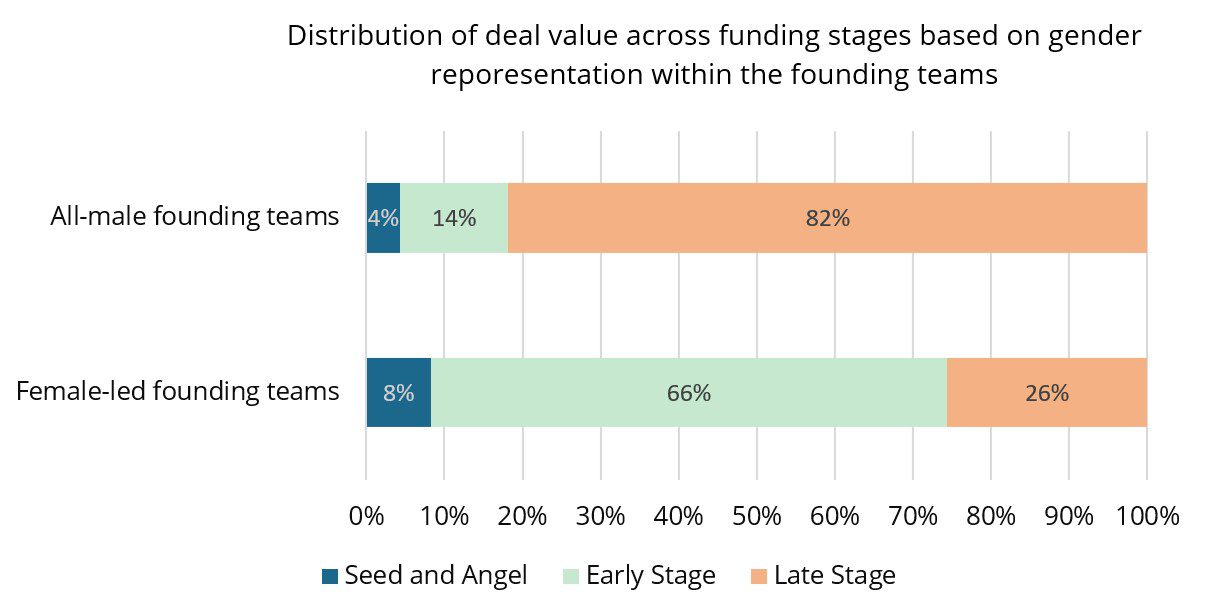
What stands out from the two graphs below is that the distribution of funding across funding stages is identical for companies with all-male founding team versus companies with at least one female founder when you look at the deal volume or number of deals. What differs is the distribution of value across these deals. 82% of the capital going to all-male teams comes from later-stage deals, while this figure is only 26% for female-led teams (by this, we mean teams comprising one or more female founders). Female-led teams get most of the funding from early-stage deals, that is Series A and Series B rounds, as well as other round types ranging from 2.5 M € to 12 M €. This suggests that even when female-led startups do receive later-stage funding, the size of the deals is likely to be smaller than for all-male founding teams.

Inequalities across countries

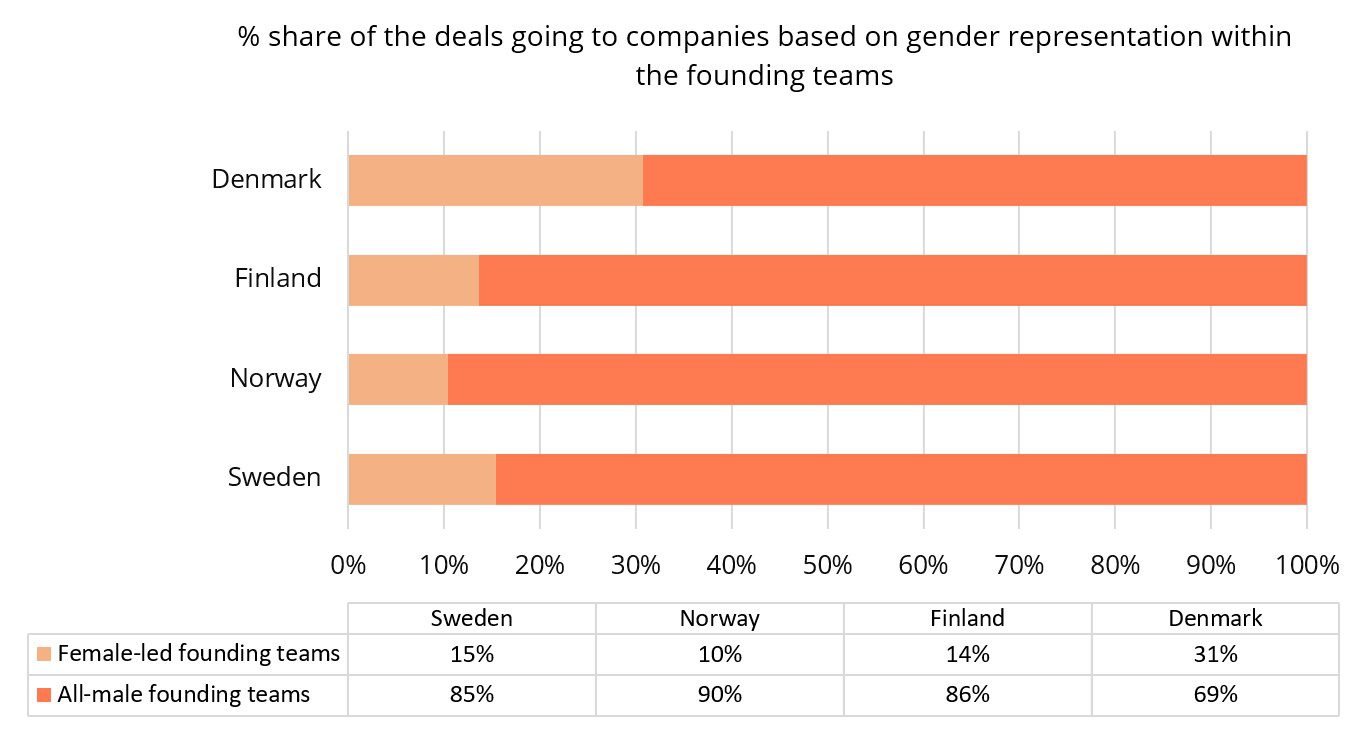
Looking at the distribution of investments across countries, Denmark clearly stands out from its Nordic neighbors. Denmark shows the best statistics in terms of gender equality with 31% of deals going to female-led teams, representing 41% of the total amount invested. Norway, on the other hand, shows striking inequalities with a similar funding distribution as that of the CCE region.

Inequalities across cleantech segments

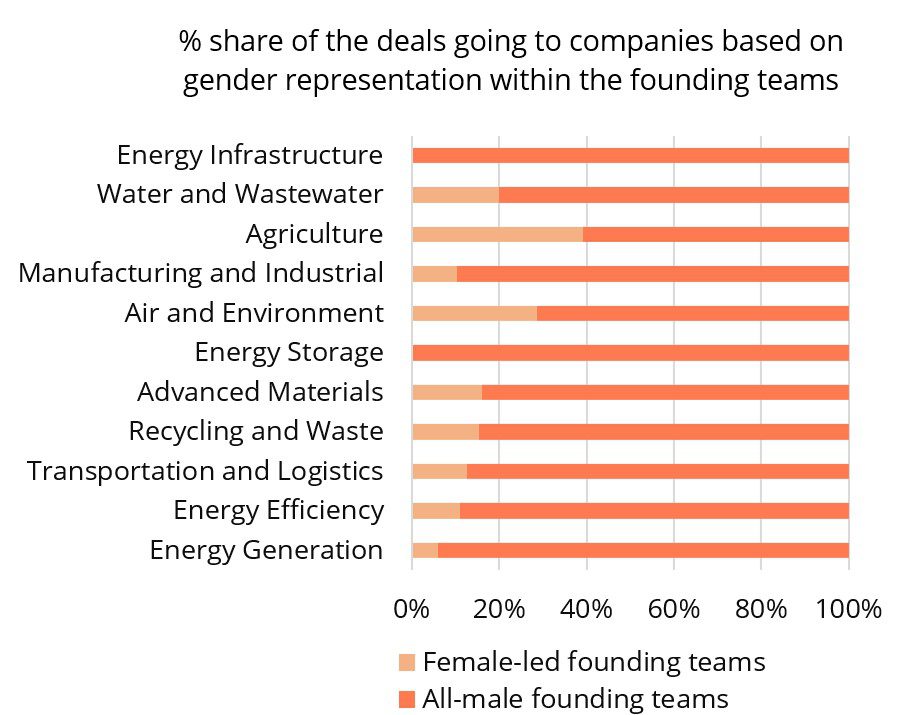
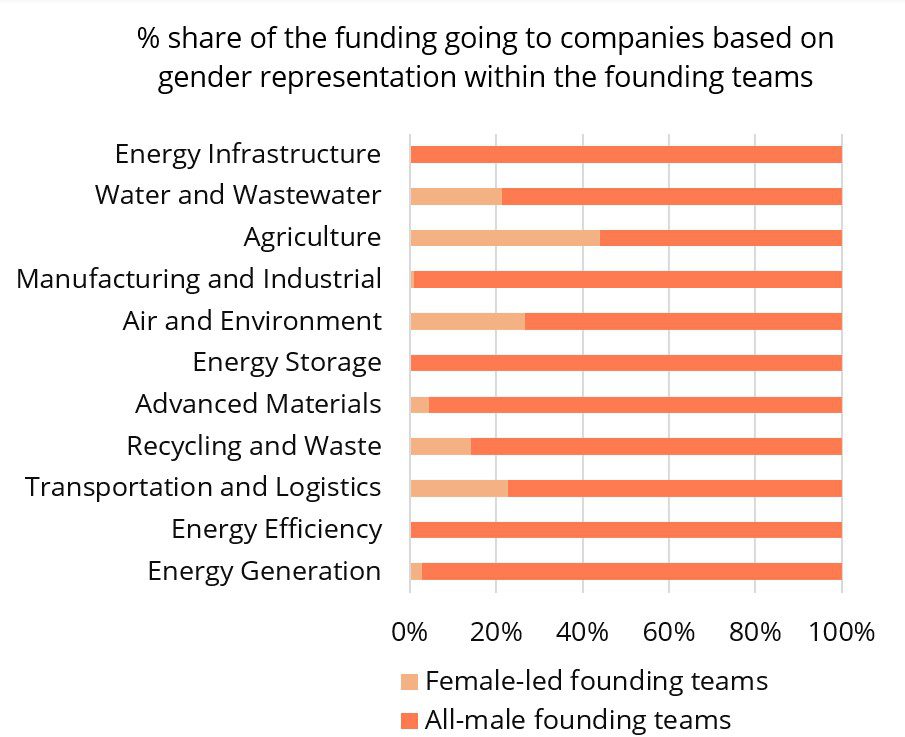
Disparities across cleantech segments are also striking. While as much as 40% of the deals in the agricultural sector went to female-led startups, other segments show figures closer to 15% and the Energy Storage and Energy Infrastructure segments did not have a single deal going to female-led startups. Looking at the percentage of funding going to female-led teams, figures show even greater inequalities. In the Transportation and Logistics sector for example, while 23% of deals went to female-led teams, this represented only 12% of the amount invested in the sector.

Our research shows that there is a major funding gap in the Nordic cleantech ecosystem. Female-led startups receive an insignificant share of the capital invested in the sector. While Nordic countries have long been championed as leaders in gender equality, this is not reflected in investment activities. As a whole, Nordic countries show the same funding disparities as the CEE region. Interestingly, Denmark stands out from its Nordic neighbors with more than one third of funding going to female-led startups. We are still, however, far from achieving equality, and women are missing out on a chance to shape our future. Or rather, we are all missing out on a better future shaped by women. Failing to address this gap constitutes a big risk, as greater female representation is not only a key driver for performance but also essential in building an inclusive, sustainable future.

References:

1 European Women in VC; Unconventional Ventures; Experior Venture Fund. (2021). Funding in the CEE region – Through the lens of gender diversity and positive impact. https://ceereport2021experiorvc.unconventional.vc

THE RACE TO NET ZERO WITHOUT WOMEN?2022-03-08T16:57:39+01:00

Impact Cafe Podcast with Vida Rozite

Our new Impact Cafe episode is an in-depth conversation about innovation, digital technologies, energy efficiency and climate change with Vida Rozite, Energy Policy Analyst at International Energy Agency. The path to Net Zero will have to include new technologies to advance, not only in energy generation but also efficiency at all scales: individual, building, city and country. However, the deployment of these technologies need to be inclusive and safe. Want to know more? Click and listen!

Who is in the podcast today?

Vida Rozite

Energy Policy Analyst

International Energy Agency

Alicia Requena.

Host. Impact Assessment Manager.

Cleantech Scandinavia.

Impact Cafe Podcast with Vida Rozite2022-01-26T09:59:29+01:00

Impact Cafe Podcast with David Miller

Our new Impact Cafe episode is an in-depth conversation with David Miller, co-founder and managing director of the Climate Impact investment group Clean Energy Ventures. In this episode, we will be discussing about strategies towards a sustainable future and the importance of data. Clean Energy Ventures has opened to the public their tool SERC to assist the entrepreneurs that apply for funding, and anyone else, to understand their impact potential. Want to know how? Click and listen!

Who is in the podcast today?

David Miller

Co-Founder and Managing Director

Clean Energy Ventures

Alicia Requena.

Host. Impact Assessment Manager.

Cleantech Scandinavia.

Impact Cafe Podcast with David Miller2021-09-22T15:07:38+01:00

GENDER EQUALITY AND THE UNTAPPED POTENTIAL TO TACKLE THE CLIMATE CRISIS

investment

-

By Aziliz Le Rouzo | September 9th, 2021

“Small side note looking at the team page of your presentation [14 pictures of men]: when do you hire your first female employee?” – Valery Prunier, Open Innovation Director Europe & International at EDF

“Interesting to see that there is not a single woman on the staff list.” – Boel Swartling, Serial entrepreneur and Angel Investor

This is some of the feedback that our jury for the 10th edition of the Nordic Cleantech Open provided to one of the 139 start-ups that applied this year. For 10 years, the Nordic Cleantech Open competition has served as an observation tower for the up-and-coming cleantech innovation trends that will support the transition to a low carbon reality. The whole competition cycle, which encompasses applications, jury evaluations and events, aims to focus the attention of international investors and industrials on cleantech innovations, accelerating their access to the global market and thereby reducing carbon emissions.

Women in Cleantech Investments: Unite!

We know the cleantech ecosystem is formed by a majority of men and we are keen to change that reality. We want to welcome you, woman working in a VC, CVC or with innovation systems to join our members network for 6 months free of charge.

Are you interested and want to know more? Reach out to us!

While the evaluation of the teams’ strengths and weaknesses are part of the jury assessment, the lack of gender diversity is rarely pointed out, despite the field being largely male-dominated. In fact, there has been little discourse in the past regarding gender representation, whether it is within the applying teams or the jury panel itself. What is certain is that neither are gender balanced. While we have seen an increase in the number of women-founded start-ups in this year’s Top 25 compared to last, the imbalance is still striking. Bringing this issue to light is merely acknowledging the tip of a giant iceberg, which we believe has a large role to play in tackling the climate crisis.

Climate Crisis – the role of investors

As the latest IPCC report warns, climate change presents widespread, rapid, and intensifying effects, and immediate large-scale action is our last hope to limit global warming to 1.5 degrees above pre-industrial levels1. There is still a possibility of achieving that goal. Clear milestones have been set, spanning across all sectors and technologies, offering a narrow pathway which requires all stakeholders to take concerted action today and every day after that for a liveable future.

In this global transition, venture investors have the extraordinary power to support the leading technologies of tomorrow. By deciding which founders receive funds, which businesses stand a chance at success and which products get brought to market, venture investors have an undeniable power to influence societal norms.

Who are these venture investors?

A recent report released by European Women in VC, using data from 2016 to 2020, reveals that only 10% of European VCs have a gender-mixed general partnership team2. While junior level positions see progress in gender equality, the same cannot be said of the upper echelons. The gender imbalance in VC firms is critical and has large repercussions on investment decisions. In fact, it is considered one of the major obstacles to funding women-led start-ups.

On the start-up scene, gender disparity is also striking. The latest PitchBook data3 indicates that despite a record amount of capital invested so far this year in Europe, female founders have received only 0.7% of the total funding, or €400 million (about $473 million). Since we did not find these statistics for start-ups in the cleantech sector specifically, we are collecting that data ourselves and plan to release gender statistics for cleantech start-ups next year. What is clear, is that this lack of diversity at the founder level prevents capital from reaching teams, products, and solutions which would be representative of a more inclusive society.

This very problem was highlighted by one of the Nordic Cleantech Open jury last year:

“I would recommend bringing some gender diversity to your team to grasp the power of different perspectives, experience and talents. Even more so since I imagine a large portion of your customers are female.” – Julian Klaiber, Investment Associate at Munich Venture Partners

Capital is too often allocated to products and services that reflect the values of an ‘old-boys club’, regardless of their market potential. While women-led businesses outperform in capital productivity by 96%, this incredible potential is left untapped2. Not only does this funding gap lead to riskier decisions by investors, it also drives the capital towards inventions which are potentially short lived. A recent scandal around yet another unnecessary feminine hygiene product developed by men illustrates that risk well4.

Investing with a gender and climate lens?

In the midst of a global climate crisis, where and to whom capital is allocated is key in determining whether we can reach our climate goals. While investments in solutions that tackle climate change need to be deployed, the importance of gender in building long-term climate solutions should not be underestimated.

Jessica Robinson, author of Financial Feminism: A Woman’s Guide to Investing for a Sustainable Future, stresses how important the role of women is in unlocking a sustainable future:

“There are so many different aspects to explore when we talk about the role that women can and already are playing in addressing the climate crisis. As founders and entrepreneurs, we are seeing more and more successful companies founded by women that are focused on sustainability and climate solutions. I genuinely believe, because I see this first-hand, that many women in business are looking to solve global challenges. At the same time, we also know that women as investors and financial decision-makers are seeking positive societal and environmental impact through their money decisions. We have the evidence that women tend to think about the long-term impact of their investment decisions and so we can bring this all together to really make a difference. If we can encourage women to be active gender-lens investors, supporting and funding female founders who are focused on delivering climate solutions, we can unleash so much potential.” – Jessica Robinson, Founder and Managing Director at Moxie Future

To conclude, the latest climate statistics show that we are running out of time to limit the magnitude of climate change. Gender lens investing should be seen as an important lever for bringing forward successful climate solutions that take into account and seek to address the gender-differentiated effects of climate change5. Let’s not risk leaving this huge potential untapped!

References:

1IPCC. (2021). Climate Change 2021: The Physical Science Basis. Contribution of Working Group I to the Sixth Assessment Report of the Intergovernmental Panel on Climate Change [Masson-Delmotte, V., P. Zhai, A. Pirani, S. L. Connors, C. Péan, S. Berger, N. Caud, Y. Chen, L. Goldfarb, M. I. Gomis, M. Huang, K. Leitzell, E. Lonnoy, J. B. R. Matthews, T. K. Maycock, T. Waterfield, O. Yelekçi, R. Yu and B. Zhou (eds.)]. Cambridge University Press. In Press

2 European Women in VC; Unconventional Ventures; Experior Venture Fund. (2021). Funding in the CEE region – Through the lens of gender diversity and positive impact. https://ceereport2021experiorvc.unconventional.vc

3Hodgson, L.  (2021). Senior female VCs call out major funding disparity in Europe. Pitchbook. https://pitchbook.com/news/articles/senior-female-vcs-call-out-major-funding-disparity-in-europe

4Mahdawi, A. (2021). Pinky Gloves are just the latest ludicrous attempt to monetise the vagina. https://www.theguardian.com/commentisfree/2021/apr/21/pinky-gloves-are-just-the-latest-ludicrous-attempt-to-monetise-the-vagina

5Biegel, S. & Lambin, S. (2021). Gender and Climate Investment: A strategy for unlocking a sustainable future. https://www.wocan.org/sites/default/files/Gender%26ClimateInvestment-GenderSmartReport-Feb21.pdf

GENDER EQUALITY AND THE UNTAPPED POTENTIAL TO TACKLE THE CLIMATE CRISIS2021-09-17T15:21:01+01:00

Impact Cafe Podcast with Jessica Robinson

Our fifth Impact Cafe episode is an in-depth conversation with sustainable and impact investment expert and author Jessica Robinson. In this episode, we will be discussing impact measurements and greenwashing, the importance of the retail investor and finntech, and last, but not least, how women as investors have a great potential to move the needle of sustainability.

Do not miss out on her book “Financial Feminism”, it is quite an eye opener!

Who is in the podcast today?

Jessica Robinson

Sustainable Finance, ESG and responsible investment expert and advisor

Moxie Future

Alicia Requena.

Host. Impact Assessment Manager.

Cleantech Scandinavia.

Impact Cafe Podcast with Jessica Robinson2021-08-23T11:23:59+01:00

Impact Cafe Podcast with Niclas Holmberg

Our fourth Impact Cafe episode helps us understand the ins-and-outs of Nasdaq, and its work in innovation and sustainability. We will be dealing with green and sustainability bonds, equality and the new Nasdaq Green Equity. This is quite a movement forward and we are sure that you will find it entertaining and enlightening.

Enjoy!

Who is in the podcast today?

Niclas Holmberg

Managing Director of Global Listings

Nasdaq

Alicia Requena.

Host. Impact Assessment Manager.

Cleantech Scandinavia.

Impact Cafe Podcast with Niclas Holmberg2021-06-24T17:02:13+01:00
Go to Top